The right material is the one that survives where your part will live. You do not have to pick: choose "Let a maker recommend", say what the item is for and where it will be used, and makers suggest a material in their quote. This guide helps you understand what they suggest.
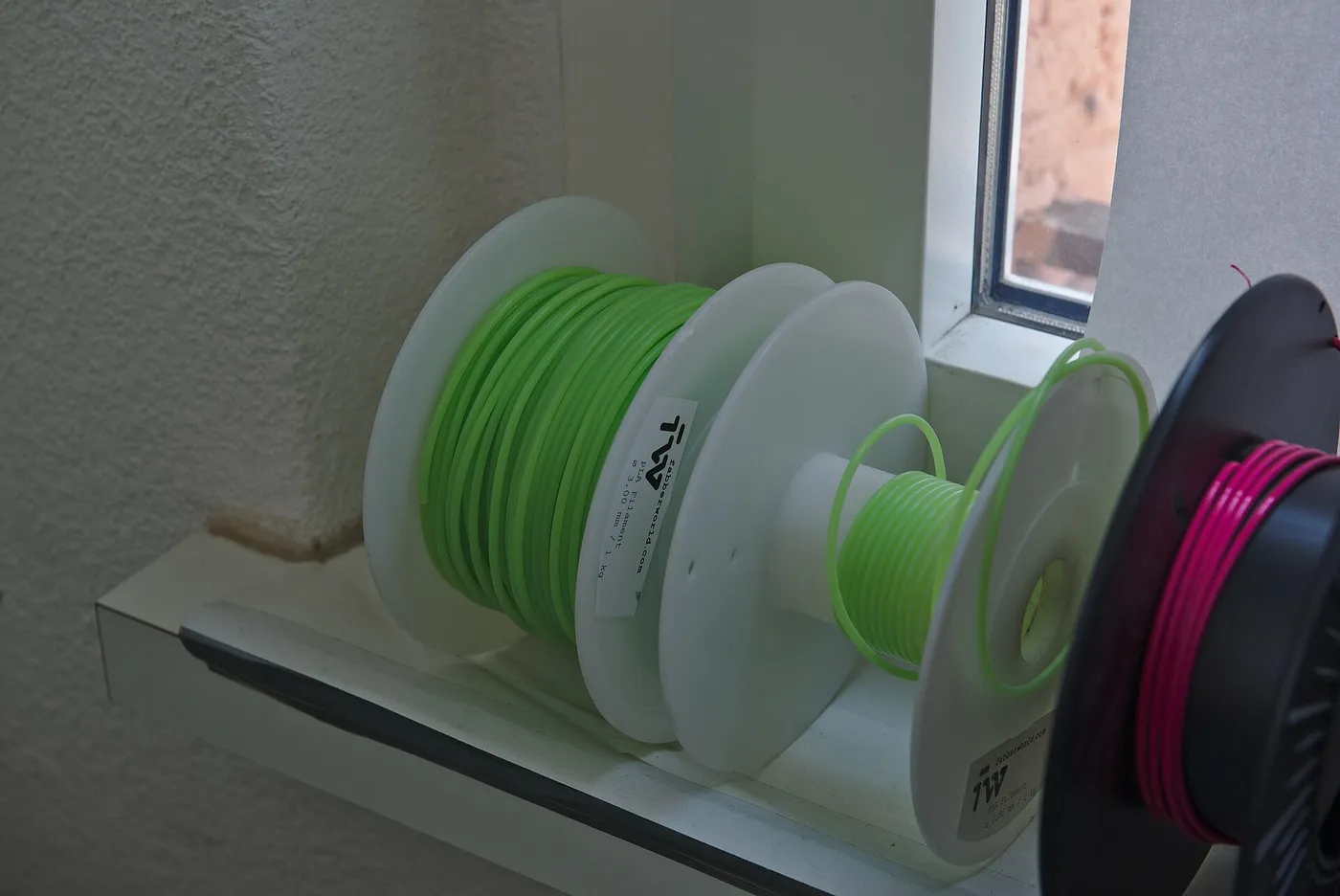 Filament: each spool is one material in one colour. Photo: Tonnerre Lombard, CC BY 2.0, via Wikimedia Commons.
The quick answer
| Your item | Start with |
|---|---|
| Gift, decor, figure, model, most indoor items | PLA |
| Handled every day, clips, holders, damp or shady spots | PETG |
| In a car, near heat | ABS or ASA |
| Outdoors in full sun | ASA |
| Has to bend or grip (bumper, phone case, gasket) | TPU |
| Gears, hinges, parts under real load | Nylon (often carbon-fibre filled) |
| Stiff and heat-proof engineering part | Polycarbonate (PC) |
| Small with fine detail: miniatures, faces, lettering | Standard resin |
| Fine detail that also gets handled | Tough resin |
Heat is the most common reason a print fails in use. A car parked in the sun reaches about 47 °C inside and close to 70 °C on the dashboard within an hour on a hot day, which is beyond everyday PLA.
Filament plastics (FDM printers)
PLA: the everyday plastic
- Good for: display pieces and gifts, figures, models, prototypes, most indoor parts.
- Looks: matte or satin, in more colours than any other material, including silk (pearl-like shine), matte, glow-in-the-dark and multi-colour prints.
- Holds up: stiff and light; fine indoors.
- Watch out: softens from about 55 °C, so not in a hot car, on a sunny windowsill for years, or near a heater. Can snap rather than bend under a sharp knock.
- Price: the lowest.
PETG: tougher everyday plastic
- Good for: parts handled every day, clips, mounts and holders, damp or shaded outdoor spots, planters.
- Looks: a slight sheen; also comes translucent, which lets light through but is not glass-clear.
- Holds up: takes more warmth than PLA (about 68 °C), and bends a little before it breaks.
- Watch out: can fade or turn brittle after years in full sun (ASA is better there). Fine detail can be a little stringy.
- Price: a little above PLA.
ABS: heat-tolerant plastic
- Good for: car interior parts, parts near heat, tough cases and housings, parts to be sanded and painted.
- Holds up: handles heat well (about 80–98 °C depending on the brand).
- Watch out: big flat parts can warp while printing, so makers need an enclosed printer, and large parts can cost more.
- Price: similar to PETG.
ASA: the outdoor plastic
- Good for: parts in full sun, garden fittings, car exterior parts, outdoor mounts and covers.
- Holds up: made to resist sun and weather, and heat to about 92 °C.
- Watch out: warps on big flat parts like ABS.
- Price: similar to ABS.
TPU: rubbery and flexible
- Good for: phone cases, bumpers, feet, grips, gaskets, anything that must bend and spring back.
- Feels: soft, slightly matte, like a firm rubber (Shore 95A is the common grade).
- Watch out: prints slowly and the filament costs more, so the same shape costs more than in PLA. Not for fine detail.
Nylon (PA) and carbon-fibre nylon (PA-CF, PAHT-CF)
- Good for: gears, hinges, clips that flex thousands of times, brackets under real load, parts that slide against each other.
- Holds up: very tough and wear-resistant. Carbon-fibre-filled nylon is stiffer and handles serious heat (one common grade is rated 170 °C under load).
- Looks: carbon-fibre blends have a matte, slightly textured black finish that hides layer lines.
- Watch out: nylon soaks up moisture from the air, so makers have to dry it before printing; it needs a hardened nozzle and an engineering-capable printer. Fewer makers offer it, and it costs more.
Polycarbonate (PC)
- Good for: stiff, heat-resistant engineering parts, covers and guards, parts near motors or lights.
- Holds up: strong and heat-resistant (about 113 °C for a common PC blend).
- Watch out: needs an enclosed, high-temperature printer; costs more; few colours.
Also on makers' lists
- PVA: a support material that dissolves in water. It is used to print complex shapes and then washed away; it is never the material of your finished part.
- HIPS, PP and specialty blends: some makers offer them. Ask in your request if you need one.
Resin (resin printers)
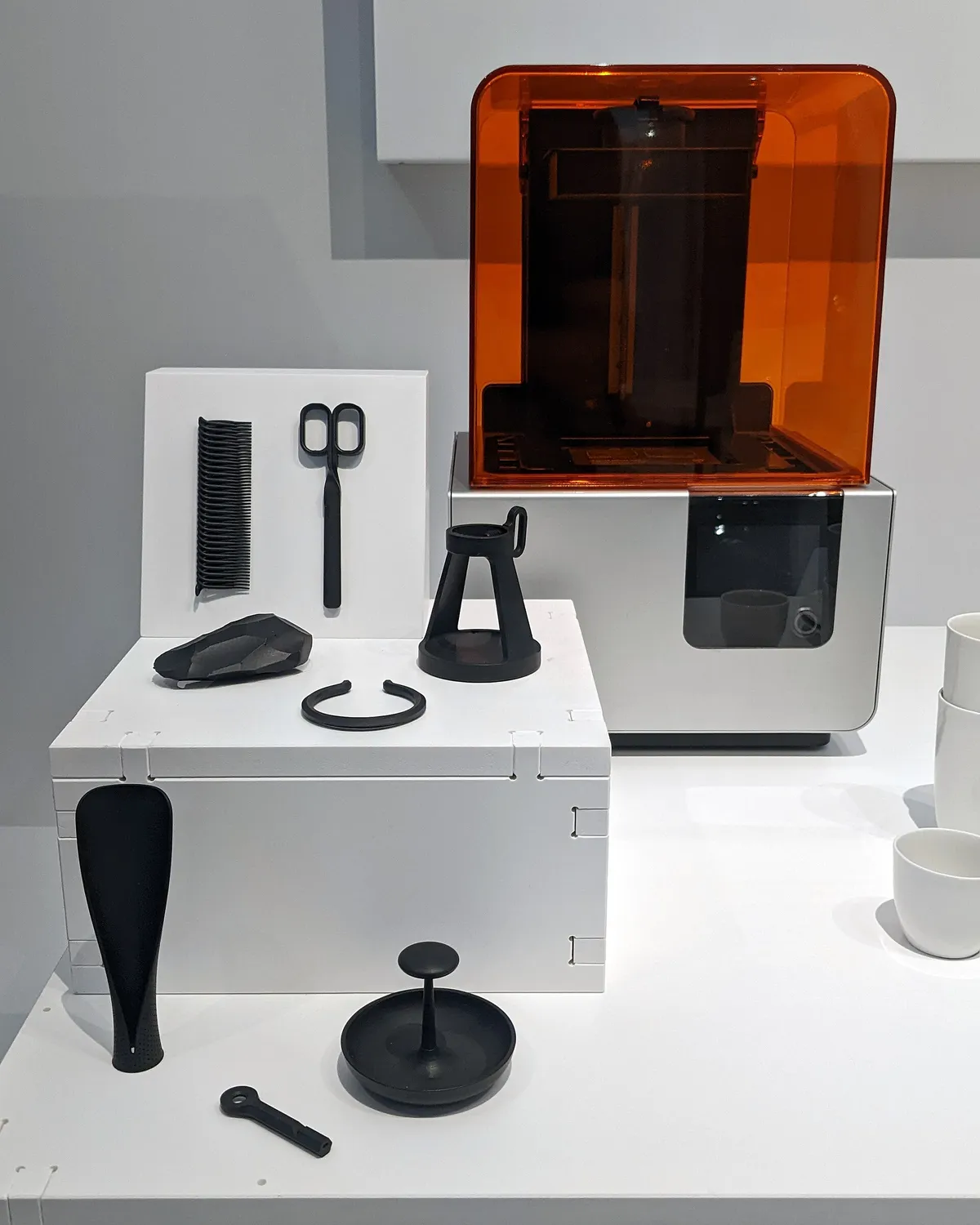 A resin printer and parts printed on it. Photo: The wub, CC BY-SA 4.0, via Wikimedia Commons.
Standard resin
- Good for: figurines and miniatures, display pieces, fine detail and small lettering.
- Looks: very smooth with sharp detail; layer lines almost invisible.
- Watch out: brittle: it can chip or snap if dropped (it stretches less than 10 % before breaking). Not for parts that take load. Fewer colors: usually grey, black, white or clear.
Tough resin
- Good for: fine parts that get handled, small clips and snap fits, detailed working models.
- Holds up: far less brittle than standard resin (one common tough resin stretches nearly 80 % before breaking, against under 10 % for standard).
- Watch out: costs more than standard resin.
Other resins
Flexible, high-temperature, castable and dental resins exist, and a few makers have them. They need specialist equipment, so mention it in your request and check the maker's quote names the exact resin. We do not offer printing certified for medical or dental use.
Food and drink
No material on this platform is offered as food safe, PETG included. The plastic a filament is made from can be approved for food contact, but a printed part is a different thing: its layer lines trap bacteria, the printer's nozzle and colorants are not controlled for food, and everyday printing plastics distort in a dishwasher. The full explanation is in Is a 3D print food safe?
Colors and finishes
- Filament comes in dozens of colors per material, with PLA offering the most. A maker may suggest the nearest color they have on the shelf.
- Silk finishes shine like satin; matte hides layer lines; translucent glows when lit but is never glass-clear.
- Multi-color printing puts several colors into one print; hand-painting is done by the maker after printing. Both add time and cost.
- Resin usually comes in grey, black, white or clear, and is painted for color.
How to choose, in three questions
- Where will it live? Indoors, in a car, outdoors in sun, near heat.
- What will it do? Sit on a shelf, get handled, take weight, bend.
- What matters most? Looks, strength, precise fit or price.
Put those answers in your request and leave the material to a maker, or pick one yourself; either way you see the maker's choice in the quote before you pay.
Sources
Figures checked against these sources on 2026-11-11. They are typical values for one brand of each material; other brands vary a little.
- PLA heat deflection 55 °C: Prusament PLA technical data sheet
- Car cabin ~47 °C, dashboard ~69 °C after an hour in sun: Arizona State University study, 2018
- PETG heat deflection 68 °C: Prusament PETG technical data sheet
- ABS heat deflection 80–98 °C: JLC3DP ABS guide
- ASA heat deflection 92 °C: Bambu Lab ASA technical data sheet
- TPU Shore 95A: Polymaker PolyFlex TPU95 data sheet
- Carbon-fibre nylon heat deflection 170 °C at 1.8 MPa: Bambu Lab PAHT-CF technical data sheet
- Polycarbonate heat resistance ~113 °C: Prusament PC Blend
- Nylon absorbs moisture and must be dried: MatterHackers: wet filament
- Standard resin elongation 8.77 %: Elegoo Standard Resin data sheet
- Tough resin elongation 79 %: Formlabs Tough 2000 Resin